
By Inteledoc Expert Team | 10 min read |
India has a weight problem that its people did not create and that generic diets cannot solve. The combination of South Asian genetics, rapidly changing food environments, chronic urban stress, and disrupted sleep has produced a biological crisis that willpower and calorie counting were simply never designed to address. GLP-1 weight loss treatment is one of the most significant clinical tools to emerge
in response to this problem — and it is now available across India.
Why India’s Weight Problem Is Biologically Different

The weight loss tips and diet plans that circulate most widely in India are adapted from research conducted predominantly on Western populations. They account inadequately for the specific metabolic reality of South Asian bodies — and this mismatch is a major reason they fail so consistently.
Research published in the International Journal of Obesity has consistently shown that South Asians accumulate abdominal fat at significantly lower body weights than European populations, and develop insulin resistance and metabolic complications at lower BMI thresholds. Standard BMI-based weight assessment tools routinely underestimate metabolic risk in Indian patients. A clinical approach that accounts for this reality produces very different recommendations than one that does not.

Traditional Indian diets — despite their many genuine nutritional strengths — tend to be high in refined carbohydrates that create rapid blood sugar fluctuations. Modern urban Indian diets compound this with ultra-processed convenience foods, irregular meal timing, and inadequate protein and fibre. This dietary pattern creates the exact biological conditions — blood sugar instability, persistent hunger, chronic fat storage — that GLP-1 treatment addresses most directly.
Elevated cortisol from chronic work pressure directly promotes abdominal fat accumulation. Sleep deprivation — endemic among urban Indian professionals — elevates ghrelin (the hunger hormone) and suppresses leptin (the fullness hormone) on a nightly basis. A person managing both of these simultaneously is fighting against their own biology every day. GLP-1 treatment helps restore the biological equilibrium that this environment continuously disrupts.
✗ Myth
GLP-1 weight loss treatments are a Western solution for Western body types. They have limited relevance for Indian patients with different genetic and dietary backgrounds.
Clinical trial data includes significant proportions of South Asian participants and shows consistent efficacy across ethnic populations. Given the particularly high burden of insulin resistance and related metabolic dysfunction in Indian patients — the exact conditions GLP-1 addresses most powerfully — the case for GLP-1 treatment in India is arguably stronger, not weaker, than in Western populations.
The Three Biological Barriers GLP-1 Breaks in Indian Patients
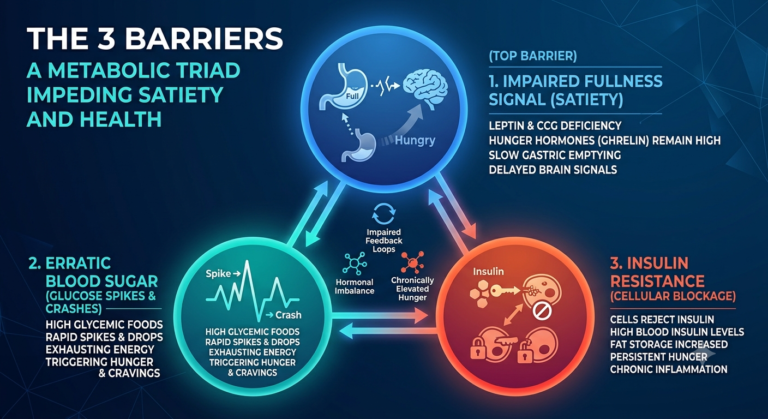
GLP-1 restores the gut-brain signal that says “you have eaten enough.” For patients who have spent years eating full meals and feeling genuinely unsatisfied within an hour — a pattern extremely common in people with insulin resistance — this restoration is transformative. Fullness becomes real, sustained, and reliable for the first time.
GLP-1 treatment stabilises blood sugar responses significantly, reducing the peaks and troughs that drive intense food cravings. For patients on high-carbohydrate Indian diets, this effect is particularly pronounced. The afternoon energy crashes and irresistible sweet cravings that derail most diet plans for weight loss reduce dramatically — without requiring the elimination of culturally important foods.
Insulin resistance — present in a very high proportion of urban Indian adults, often undiagnosed — essentially locks the body into chronic fat-storage mode. GLP-1 treatment directly improves insulin sensitivity, helping unlock this pattern and allowing the body to shift from storing fat to releasing and burning it. This is the barrier that most conventional weight loss diets cannot overcome, and it is one of GLP-1’s primary mechanisms of action.
What a Properly Run GLP-1 Programme Includes
The quality of GLP-1 programmes varies enormously across India. Understanding what a proper programme should include helps you evaluate any provider accurately.
1. Through pre-treatment medical assessment.
Including metabolic blood panel, hormonal assessment, cardiovascular baseline, and evaluation of any conditions that affect treatment suitability. No prescription should be issued without this.
2. Careful, gradual dose titration.
Starting at the lowest dose and increasing slowly based on individual response. This is the single most important factor in both safety and tolerability. Providers who rush to higher doses to accelerate results compromise both.
3. Personalised nutritional guidance.
A weight loss diet built around your specific metabolic results and Indian dietary preferences — not a generic low-carb template. Proper protein targets, appropriate carbohydrate management, and culturally sustainable meal structure.
4. Regular clinical monitoring.
Check-ins every two to four weeks assessing weight, metabolic markers, side effects, and programme adherence. Adjustments made based on real progress, not a fixed protocol.
5. Long-term maintenance planning.
A plan for what happens after active treatment ends — including the lifestyle and dietary habits needed to sustain results. This step is omitted by many providers and is a primary reason for weight regain.
Explore Inteledoc’s complete GLP-1 weight loss programme in Gurugram, and read our guides on doctor supervised weight loss in India and weight loss injections — myths and facts.
✓ One Question Worth Asking
Before starting any GLP-1 programme in India, ask your provider: who is the doctor overseeing my treatment? How is my dose managed and adjusted? What happens if I have side effects? What nutritional support is included? The answers reveal everything about whether the programme is genuinely clinical or simply a prescription service.
Frequently Asked Questions
Yes. GLP-1 based medicines including liraglutide and semaglutide are approved by India’s Central Drugs Standard Control Organisation (CDSCO) for both type 2 diabetes management and weight management, subject to physician prescription and appropriate clinical indication.
Well-designed programmes adapt fully to Indian dietary practices. The appetite reduction GLP-1 produces makes managing portion sizes of traditionally high-carbohydrate Indian foods significantly easier, without requiring the elimination of culturally important meals.
Yes. GLP-1 medicines directly improve insulin sensitivity and blood sugar regulation, and are among the most evidence-supported interventions for preventing the progression from prediabetes to type 2 diabetes. This is particularly relevant for Indian patients, who have a significantly elevated risk of diabetes-related complications.
Absolutely. The GLP-1 medicine itself contains no animal products. Your personalised diet plan will be fully adapted to vegetarian requirements, with specific attention to protein adequacy and micronutrient coverage — areas where vegetarian weight loss programmes often fall short without expert guidance.
The same class of medicines is used for both indications. The doses prescribed specifically for weight management are typically higher than those used for diabetes management alone. The clinical assessment, monitoring, and programme structure differ accordingly.
Long-term safety data from clinical trials extending beyond two years shows a strong safety profile for GLP-1 medicines at doses used for weight management. Ongoing monitoring under doctor supervision is recommended for patients on long-term programmes.
Bariatric surgery is a permanent anatomical intervention producing more dramatic weight loss in severely obese patients. GLP-1 programmes are non-surgical, reversible, and appropriate for a much wider range of patients. They are increasingly seen as an effective intermediate intervention between lifestyle modification and surgical options.
The first step is a consultation — available online from anywhere in India or in person in Gurugram. Your doctor reviews your full health picture and gives you an honest assessment of whether GLP-1 treatment is appropriate for you, what to expect, and what the complete programme involves. Book here.
Ready for a weight loss plan built around your body?
Doctor-supervised care in Gurugram & across India — online and inperson consultations available.
Book a consultation